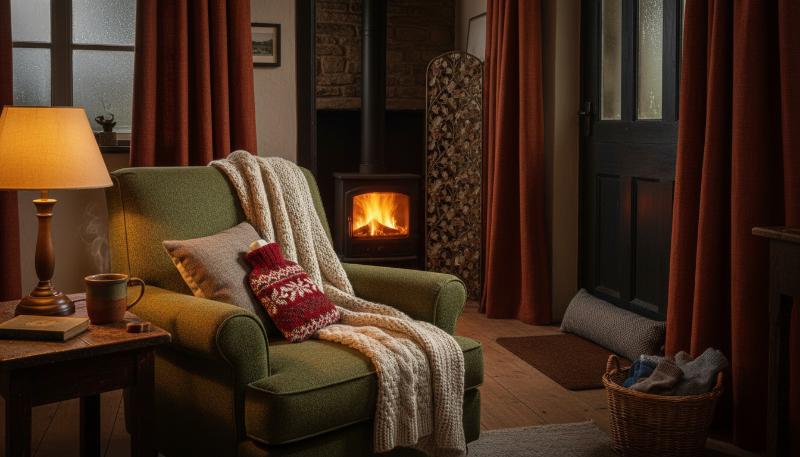

It’s that time of year in the UK when the temperature has dropped and you’re debating whether it’s time to put the heating on or not. The issue is that the decision has become a slightly harder one to make due to the rising costs of energy in the UK and the noticeable uplift in your gas and electricity bills.
The current price cap sits at £1,723 a year for a typical home, around 4% up on last winter, with electricity at 26.32p per unit and gas at 7.97p. Those numbers have become so much a part of the background noise that it’s easy to feel there’s nothing much left to do about them beyond putting up with being cold, which isn’t really true.
Here’s the thing that gets lost in most advice about this. A fair amount of staying warm has very little to do with how much heat you buy, and rather more to do with how much of it you manage to hang onto, and where you choose to put it. So in this article we’re going to go through some creative ways to save money staying warm this winter, starting with the ones that cost nothing at all and working up to the ones worth actually spending on.
Start by finding out where your heat is escaping
If you only do one thing from this list, make it this one, because draught proofing is consistently the cheapest meaningful change anyone can make to a home and the materials cost less than a weekly shop.
The places worth looking are mostly the ones nobody thinks about. Under and around external doors, where a brush strip or a draught excluder does the job. The letterbox and the keyhole, which sound trivial until you hold your hand near them on a windy evening. Gaps around window frames, which take self-adhesive foam strip and about twenty minutes. Floorboards and skirting gaps in older houses, where flexible filler works well. The loft hatch, which is often the single biggest hole in an otherwise insulated ceiling. And any unused chimney, where a chimney balloon or draught excluder stops warm air disappearing straight up it.
What makes this worth doing first is that every other thing on this list works better afterwards. There’s not much point paying to heat air that’s on its way out through a gap under the back door.
Check your boiler’s flow temperature, because it’s probably set too high
This is the one almost nobody knows about, and it costs nothing whatsoever to change.
Most condensing combi boilers in the UK leave the factory, or get left by the installer, with a flow temperature somewhere between 70 and 80°C. That sounds like it should be a good thing, except that a condensing boiler only reaches its proper efficiency when the water coming back from your radiators is cool enough for it to condense, and at those settings it never gets the chance. Research by Nesta found that optimising this setting cut gas use and costs by around 8%, which is a remarkable return on a change that involves turning one dial.
Worth being clear on two points. This applies to combi boilers rather than systems with a hot water cylinder, and you’re adjusting the radiator flow temperature, not your hot water, so your showers stay exactly as hot as they were. Your house will take slightly longer to warm up and will then hold its temperature more steadily, which most people find they prefer once they’ve got used to it.
Keep yourself warm and don’t worry about the room temperature
This is where the thinking gets genuinely useful, because heating a whole room to warm up one person sitting still on a sofa is a fairly inefficient way round of doing things.
A heated throw is the standout here. Most draw somewhere around 100 watts, which at current electricity prices works out at roughly 2.6p an hour, and that is a remarkable amount of comfort for the money. An electric blanket or a heated mattress topper does something similar at bedtime, and means you can let the house get genuinely cool overnight without dreading getting into bed.
Beyond the electrics, the old-fashioned stuff earns its keep. Swapping to a higher tog duvet for the winter months, which is a one-off cost that lasts years. Thermal or simply heavier lined curtains, closed as soon as it gets dark, which make a noticeable difference to how a room holds its warmth. A rug on a bare wooden or tiled floor. And layers that actually work, meaning something close-fitting underneath rather than one thick jumper over a T-shirt, because it’s the trapped air between layers doing the insulating.
None of this is glamorous advice. It is, however, the reason your grandparents’ houses were survivable.
Heat the one room you’re in
Here’s the sum that surprises people. Your central heating doesn’t warm the room you’re sitting in, it warms your entire house, including the spare bedroom, the hallway and the bathroom at two in the afternoon. In January, with a full house, that’s exactly right. On a Tuesday in October when you’re working from home on your own, it’s a lot of heat going to places nobody is.
A 1,650W heater fan costs around 43p an hour at full output, and considerably less than that once a thermostat starts cycling it to hold a temperature rather than running flat out. Set against roughly 50p to over £1 an hour to run gas central heating through a typical house, heating one room comes out meaningfully cheaper, particularly across a full working day.
Two honest caveats, because this only works within limits. Per unit of heat, gas is about three times cheaper than electricity, so the saving comes entirely from heating less space rather than from the fuel being cheaper. Run one of these in every room, and you’ve lost the advantage completely. And the unit genuinely needs a thermostat, because a heater without one simply runs at full power until you remember to switch it off, which is where the saving quietly disappears.
If you’re considering it, the vortex air heater fans are worth a look on that basis, with a built in thermostat, a timer up to nine hours and the useful detail that the same unit works as a cooling fan in summer, so it isn’t an appliance that sits in a cupboard for eight months of the year.
Incidentally, this is the same logic that makes log burners appealing, and they do heat a single room beautifully. The catch is that installation typically runs well into four figures before you’ve bought any wood, so it’s a long-term investment in your house rather than a way through this particular winter.
Make sure you’re claiming what you’re owed
Last, and this matters more than any of the above if money is genuinely tight. Check whether you qualify for the Warm Home Discount, whether your council runs a Household Support Fund scheme, and whether anyone in your household should be on the Priority Services Register, which is free and offers extra support from your supplier and network operator.
Suppliers have obligations here that plenty of people don’t realise they can call on, and if you’re struggling to pay, telling them early gives you considerably more options than telling them late. There’s no shame in any of it, and a surprising number of people who are entitled to help have simply never applied.
Final thought
Do set a floor and stick to it. Around 18°C is the recommended minimum for living spaces, and that matters a good deal more if anyone in the house is elderly, very young, pregnant or managing a health condition. Letting a home get properly cold also brings on condensation and damp, which costs far more to put right than the heating ever saved.
Being warmer for less money is a perfectly achievable goal. Being cold to save money isn’t a saving at all.
Sources: Ofgem price cap, October to December 2026 · Nesta Money Saving Boiler Challenge